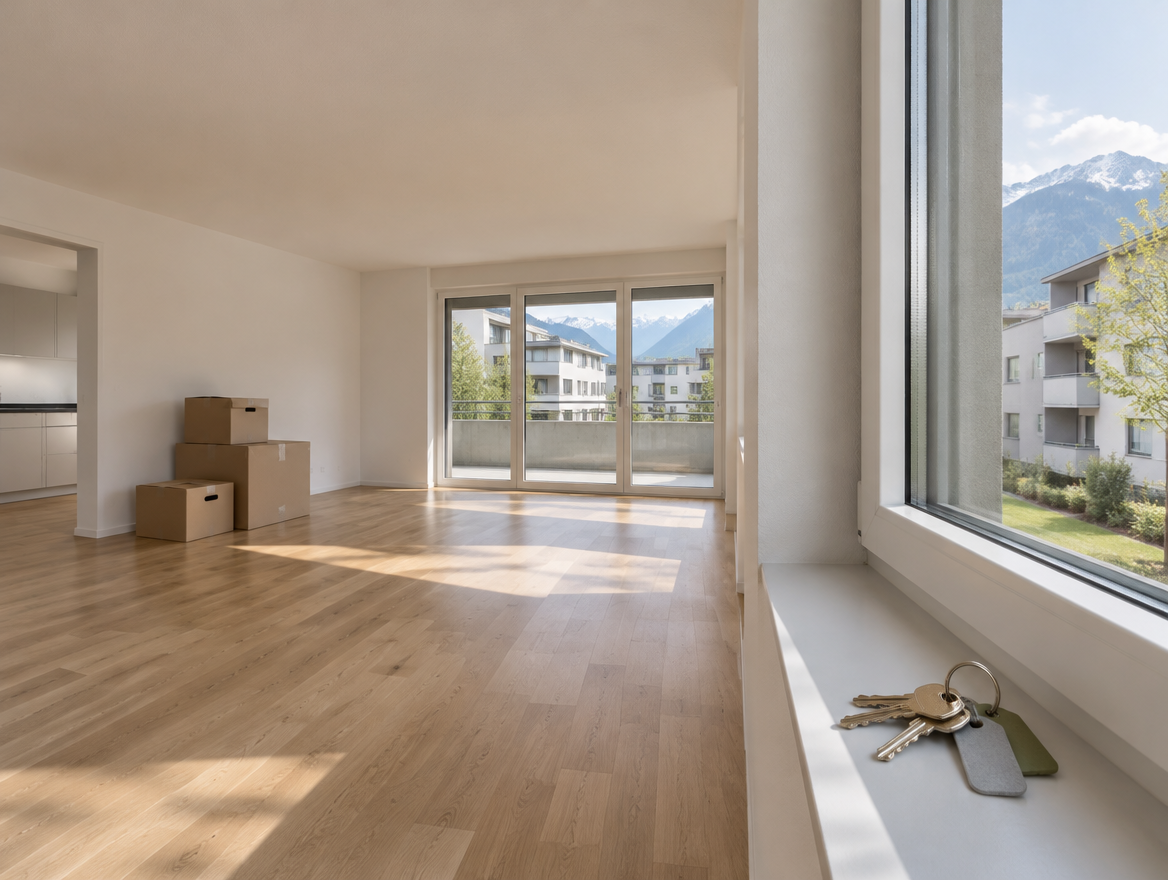
In short: In a first letting, the apartments of a new building are let for the first time, usually all within a short period and often before construction is finished. The ordinary rules of tenancy law apply: the initial rent can be challenged within 30 days, many cantons require the official form for it, and the apartment must be ready to move into on the agreed date. This article shows the process from planning to move-in.
What is a first letting?
In a first letting, the apartments or commercial premises of a new building are let for the first time. Unlike a re-letting, there is no previous rent, no handover report from a former tenant and no operating experience. Instead, many tenancy agreements are concluded at once, often with the same move-in date, and marketing usually starts before the building is finished.
Legally, the ordinary rules of tenancy law in the Code of Obligations (CO) apply. What makes a first letting demanding is the schedule: rents, marketing, applications, contracts, completion of construction and handover all have to fit together.
The first letting process: from planning to move-in
The phases overlap, especially in large developments with move-in in stages. The overview shows what needs to be clarified in which phase.

| Phase | What needs to be clarified | Who is involved |
|---|---|---|
| Planning | Target group, apartment mix, rents, service charge model, access and digital services in the building | Owners, project development, future property management |
| Marketing | Project website, visualisations, floor plans, listings, viewings of a show apartment or the site | First letting team or marketing agency |
| Applications and selection | Application form in line with data protection law, selection criteria, acceptances and rejections | Property management |
| Conclusion of contracts | Tenancy agreement, form for the initial rent (where required), rental deposit, house rules | Property management, tenants |
| Handover | Inspection of the apartment, handover report with list of defects, keys or access rights, introduction to appliances and app | Property management, site management, tenants |
| After move-in | Collect defects and pass them on to the contractors, warranty work, tenants' questions | Property management, site management, contractors |
For the owners, a rent roll during the first letting shows which units are let, at what rent and from when.
Initial rent and form requirement
Tenants can challenge the initial rent as abusive before the conciliation authority within 30 days of taking over the property (Art. 270 para. 1 CO). This also applies to new buildings. Because there is no previous rent in a first letting, only the first ground for challenge is possible: the tenants felt compelled to conclude the contract because of personal or family hardship or because of conditions on the local housing market (Art. 270 para. 1 let. a CO).
For new buildings, a rent is generally not abusive if it is within the range of a cost-covering gross yield (Art. 269a let. c CO). Whoever sets the rents should therefore document the calculation from investment costs and yield, so that it is available in the event of a challenge.
Where there is a housing shortage, cantons can require that the initial rent be notified on the official form when a new tenancy agreement is concluded (Art. 270 para. 2 CO). According to the Federal Office for Housing (FOH) list for 2026, the form requirement applies here:
| Canton | Form requirement 2026 |
|---|---|
| Basel-Stadt, Bern, Fribourg, Geneva, Lucerne, Zug, Zurich | yes, throughout the canton |
| Neuchâtel | in some municipalities, depending on the number of rooms |
| Vaud | in all districts except Aigle |
| other cantons | no |
The cantons adjust the form requirement annually to the vacancy rate. What counts is the list for the year in which the contract is concluded. The form also states the reference interest rate and the level of the consumer price index on which the rent is based. The FOH publishes the current reference interest rate quarterly. How later adjustments work is explained in the article on rent increases.
Applications: what the application form may ask
In a first letting, many applications come in within a short time. The Federal Data Protection and Information Commissioner (FDPIC) sets out in a fact sheet which information landlords may request and when. The main points:
| When | Information |
|---|---|
| Permitted in the application form | Personal and contact details, residence status for foreign nationals, number of occupants, occupation and employer of the signatories, approximate income (preferably in ranges), ongoing debt enforcement proceedings and certificates of unpaid debts from the last five years, pets |
| Only at the shortlisting stage | Copy of ID or residence permit, salary statement, original extract from the debt enforcement register, references |
| Not permitted | Marital status, religion, nationality as such, questions about leasing or consumer credit agreements, length and amount of the current rent, systematic references on all applicants |
Application documents may only be used for the advertised apartment. As soon as the tenancy agreement is signed, the documents of the other applicants are destroyed. A list of interested parties for later apartments or further stages is only permitted with the consent of those concerned.
Handover: move-in date, defects and report
The landlord must hand over the apartment on the agreed date in a condition fit for the intended use (Art. 256 para. 1 CO). If the new building is not finished on time, tenants can proceed under the rules on default of the obligor (Art. 258 para. 1 in conjunction with Art. 107 to 109 CO): they set a reasonable additional deadline and can then either uphold the contract and claim damages or withdraw from it. Withdrawal is only possible if living there is impossible or unreasonable. If the apartment is habitable but still defective, a rent reduction and remedying of the defects remain (Art. 258 para. 3 and Art. 259a CO).
For property management this means: agree a realistic move-in date, communicate postponements early and in writing, and coordinate the completion of construction closely with site management.
A handover report is also needed for a new apartment. It records which defects exist at move-in, such as scratches, missing silicone joints or appliances that do not work. A template for the apartment handover report is available in the article on the apartment handover. Tenants report defects that only become apparent in the first few weeks to property management, which collects them and passes them on to site management and the contractors, who carry out remedial work under their warranty.
Set up the digital basics before move-in
Whether access by badge or smartphone, parcel boxes, EV charging stations or a tenant app: anything not thought through digitally during construction can only be retrofitted at great expense once the building is in use. For the first letting, early planning has two advantages. Tenants receive all access at once when they move in, and property management does not have to organise keys, badges and information for each apartment individually.
With Build, Allthings plans access, onboarding and automations for the new building during the construction process. At first move-in, tenants receive their access to the Allthings app with building information, documents and the contact to property management. How Allthings supports new buildings from planning to commissioning is shown in the solution for new buildings.
First letting checklist
- Set the rents and document the calculation (investment costs, gross yield)
- Check whether the form requirement for the initial rent applies in the canton
- Draw up the application form in line with the FDPIC fact sheet
- Obtain consent if applicants are put on a list for further stages
- Prepare the tenancy agreement, house rules, form and documents for the rental deposit
- Coordinate the move-in date with site management, communicate postponements early
- Set up access, parcel boxes, EV charging stations and the app before move-in
- Prepare a handover report with a list of defects for each apartment
- Collect defects after move-in and pass them on to the contractors in bundles
- Destroy the documents of rejected applicants once the contract has been concluded
Sources
- Swiss Code of Obligations (CO), Art. 256, 258, 259a, 269a and 270 (fedlex, SR 220)
- FOH: list of cantons with a form requirement for notifying the initial rent, 2026
- FDPIC: fact sheet on application forms for rented apartments (updated 15.07.2025)
- Courts of the canton of Zurich: defects in the rented property
- Swiss Tenants' Association: fact sheet on defects at move-in
Information as of 16 November 2026.