In short: House rules govern how people live together in a building: quiet hours, laundry room, stairwell, waste and the use of shared areas. They are binding if they form part of the tenancy agreement. Their legal basis is the tenants' duty of care and consideration under Art. 257f CO.
What are house rules?
House rules are a set of rules issued by the landlord that lay down how the residents of a building use their apartments and the shared rooms. They apply equally to all tenants of a building and create a common standard: when is it quiet? Who washes when? Where do bicycles and prams go?
Switzerland has no statutory model house rules. Associations such as the Homeowners' Association (HEV) offer templates, and many property managers use their own versions. In substance, most house rules are very similar. In the details, they differ from building to building, for example where there is no caretaker, no lift or no shared laundry room.
Are house rules legally binding?
Yes, if they form part of the tenancy agreement. That is the case when the agreement expressly refers to the house rules and they are handed to the tenants when the agreement is concluded, for example as an annex. A notice in the stairwell alone does not make house rules part of the contract.
The law applies regardless. Under Art. 257f CO, tenants must use the property with care and show consideration for other residents and neighbours. House rules make this general duty concrete. Inconsiderate behaviour, such as loud music late into the night, is therefore a problem even where no house rules have been agreed.
House rules reach their limits where a rule has no objective reason, unduly restricts private life or introduces additional obligations. According to the Swiss Tenants' Association, a general ban on playing music or a fixed maximum number of wash cycles does not belong in house rules. Practice times for instruments and a laundry schedule, on the other hand, do.
What rules do house rules typically contain?
Most house rules cover quiet hours, the laundry room, the stairwell, waste, pets, balconies and barbecues, and bicycles and prams. The following overview shows what is customary. What counts is always the version that belongs to your tenancy agreement.

Quiet hours
House rules usually set night-time quiet hours and a midday break, plus quiet on Sundays and public holidays. The information platform of the canton of St. Gallen gives as an example a midday break from 12 to 1 pm and night-time quiet from 8 or 10 pm to 6 or 7 am; Sundays and public holidays count there as rest days all day.
Important: municipalities and cantons have their own noise regulations, which apply regardless of the house rules. One example is the city of Zurich. Its general police ordinance sets night-time quiet from 10 pm to 7 am, and during summer time from 11 pm to 7 am on Fridays and Saturdays (Art. 19 APV). The times that apply where you live are set out in your municipality's police ordinance.
Quiet hours do not mean absolute silence. According to the Swiss Tenants' Association, a short shower after 10 pm or children's noise during the day are part of normal living. House rules may restrict the times for playing music, but not ban it altogether.
Laundry room and laundry schedule
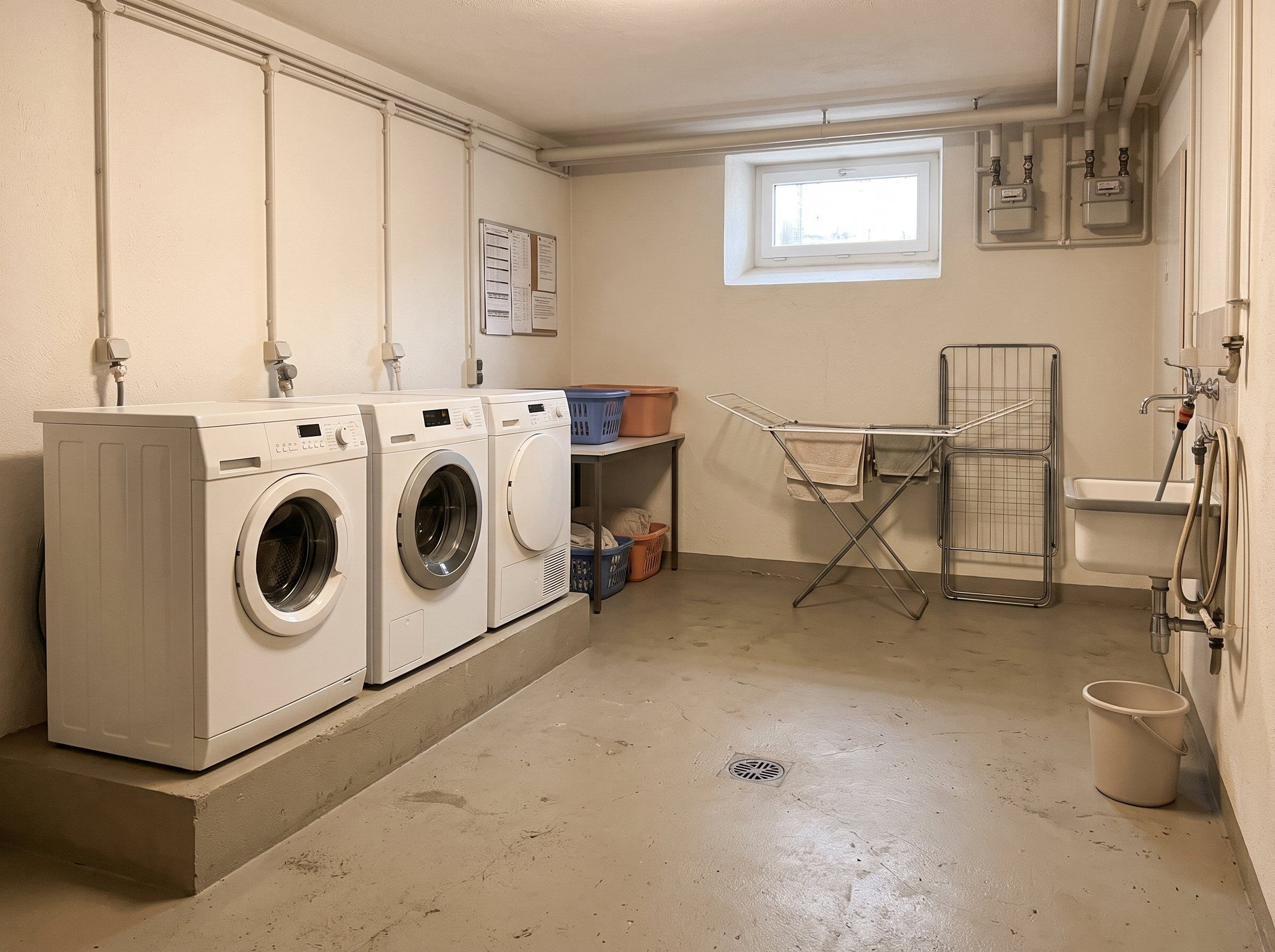
Where several households share a laundry room, a laundry schedule sets out who may wash when. Common rules are a fixed washing day or fixed time slots per household, cleaning the laundry room and machines after use, taking the laundry down from the drying room in good time and no use at night. The canton of St. Gallen gives as an example that the washing machine and tumble dryer may not be used between 10 pm and 6 am. Whether washing is allowed on Sundays is up to the individual house rules.
Only use other households' free slots by arrangement. If you want to wash outside your slot, ask the household concerned first.
Stairwell, entrance and shared rooms
The stairwell is an escape route and must be kept clear at all times under fire safety regulations. Some house rules tolerate prams or walking aids there if enough space remains, while some municipalities rule that out too. Shoes, rubbish bags, furniture or bicycles do not belong in the hallway. There are also rules on closing the front door, the smoking ban in the lift and stairwell, and cleaning, unless a caretaker does it.
Waste and recycling
Waste belongs in the designated containers and collection points, not in the hallway, the laundry room or on the balcony. The municipality decides how waste is separated and collected and whether fee bags are required. House rules therefore often refer to the municipal waste regulations and the collection calendar.
Pets
House rules usually govern behaviour with animals in shared rooms, such as dogs on a lead in the stairwell or no feeding of pigeons. Whether a dog or cat may be kept is usually set out in the tenancy agreement. Small animals such as ornamental fish or hamsters are generally allowed in usual numbers.
Balcony, patio and barbecues
Barbecues on the balcony are allowed in many buildings as long as smoke and smell do not unduly disturb the neighbours. House rules often restrict the type of grill, for example electric or gas yes, charcoal no. In addition to the duty of consideration under tenancy law, neighbour law applies: excessive nuisance from smoke, smell or noise is prohibited (Art. 684 CC).
Bicycles, prams and vehicles
Bicycles, scooters and motorbikes belong in the bicycle room or in the designated parking spaces. Prams ideally go there too, and in the stairwell only if the house rules allow it. Visitor parking spaces are meant for guests, not as extra space for tenants.
Can you do laundry on Sundays?
There is no nationwide ban: whether laundry may be done on Sundays is decided by the building's house rules, within the rest day rules of the canton and municipality. No federal law governs washing on Sundays and public holidays.
Cantons and municipalities protect Sundays and public holidays with their own regulations. These usually prohibit disturbing noise but allow ordinary household chores. One example is the Sunday rest regulation of the municipality of Ostermundigen (canton of Bern): it prohibits causing disturbing noise on public holidays (Art. 2 para. 1) and expressly allows work to run the household (Art. 5 let. b). Other municipalities word this differently; what counts is always the regulation where the building is located.
In practice, the house rules therefore decide. Many versions declare Sundays and public holidays rest days and close the shared laundry room on those days. Others allow washing, often with shorter hours. Night-time quiet applies regardless of the day of the week: the canton of St. Gallen gives as an example that the washing machine and tumble dryer are not used between 10 pm and 6 am.
A clear rule pays off for property managers, because the question leads to disputes in many buildings:
| Rule in the house rules | When it makes sense | What to set out |
|---|---|---|
| No washing on Sundays and public holidays | Laundry room next to apartments or bedrooms, poorly insulated buildings | Expressly include or exclude public holidays that fall on a weekday |
| Allowed with shorter hours | Large buildings with a fully booked laundry schedule | Time slot, for example from midday until night-time quiet begins |
| Allowed as on weekdays | Washing machine in the apartment or soundproofed laundry room | Night-time quiet and consideration for neighbours remain |
A washing machine in your own apartment counts as an ordinary household chore. Even then, the duty of consideration under Art. 257f CO applies: a loud spin cycle in the middle of the night can disturb the neighbours unreasonably, whether or not it is Sunday.
If you change the rule, for example after installing additional machines, inform all tenants in advance. With Allthings digital tenant communication, a changed laundry room rule reaches all tenants of the building in one step.
Can the landlord change the house rules?
Only to a limited extent. If the house rules are part of the tenancy agreement, a change to the tenants' disadvantage is a unilateral amendment of the contract. The same rules apply as for a rent increase: the landlord must give notice of the change on the form approved by the canton and state the reasons, at least ten days before the notice period begins, effective from the next possible termination date (Art. 269d para. 3 CO). Without the form or the reasons, the change is void.
It is different for adjustments that leave nobody worse off, such as a new laundry schedule after additional machines are installed or the municipality's changed collection dates. Property managers can usually announce such organisational changes without the official form. A change can also be agreed by mutual consent with all tenants.
What happens when house rules are breached?
Breaches are dealt with step by step: a conversation, a report to the property manager, a written warning and, as a last resort, termination.

1. Talk to the neighbours. Many conflicts are resolved if the problem is raised calmly and promptly.
2. Report to the property manager. If talking does not help, those affected report the disturbance in writing, with date, time and a short description.
3. Written warning. The property manager asks the household responsible in writing to comply with the rules.
4. Termination. If a tenant keeps breaching the duty of care or consideration despite a written warning, so that continuing the tenancy can no longer reasonably be expected of the landlord or the residents, the landlord can terminate a residential tenancy with at least 30 days' notice to the end of a month (Art. 257f para. 3 CO). Termination requires the official form (Art. 266l CO). The tenant can challenge it before the conciliation authority within 30 days (Art. 273 CO).
The tenants who are disturbed also have rights. If they are disturbed in the contractual use of their apartment, for example by constant noise, they can require the landlord to remedy the defect or reduce the rent proportionately (Art. 259a CO). For property managers this means: take complaints seriously and document every step.
House rules in property management: distribute, remind, resolve conflicts
For property managers, house rules are above all a communication task. All tenants must know the current version, changes must reach everyone, and conflicts need a traceable record.
Provide the house rules digitally. The house rules belong as an annex to every tenancy agreement. It also helps to store them digitally so that all residents can find them at any time, including flatmates who did not sign the agreement. In the Allthings tenant portal, documents such as the house rules can be stored at building level and made available centrally to all tenants.
Remind rather than warn. Many breaches arise from not knowing: new tenants, changed collection dates, the start of barbecue season. A short message to all residents works better than a notice that gets overlooked. With Allthings digital tenant communication, property managers reach all tenants of a building via app and portal in one step.
Book the laundry room digitally. A fixed laundry schedule does not suit every household. A digital booking shows free time slots and prevents double bookings. Via the Allthings app, tenants can reach connected booking solutions for washing machines, such as washMaster by Schulthess or Miele appWash. House rules, such as hours of use and cleaning after use, should be visible when booking.
Strengthen the neighbourhood. Conflicts often ease when neighbours know each other and can arrange things directly, for example before a party on the balcony or to swap a washing day. The Allthings community features provide a digital notice board for the building.
Document conflicts. Record complaints, conversations and warnings for each tenancy. If it comes to termination, the landlord must be able to prove the written warning and the continued breach.
Template: download house rules for free
Our template (in German) contains the usual sections of house rules for rented apartments in Switzerland and can be adapted to any building: scope, quiet hours, laundry room, stairwell and shared rooms, waste, bicycles and parking, balcony and barbecues, pets, cellar and attic, ventilation and heating, damage reports and entry into force. For quiet hours it contains placeholders so you can enter your municipality's times. A laundry schedule as a weekly grid is included.
The template does not replace legal advice. Before using it, check that it fits your tenancy agreements and your municipality's regulations.
Sources
- Swiss Code of Obligations (CO, SR 220): Art. 257f, 259a, 266l, 269d and 273, fedlex.admin.ch (version of 1 October 2026)
- Swiss Civil Code (CC, SR 210): Art. 684, fedlex.admin.ch
- Example municipality: City of Zurich, general police ordinance (APV, AS 551.110), Art. 19, as of 28 September 2025
- Example canton: Canton of St. Gallen, information platform hallo.sg.ch, page on house rules
- Example of Sunday rest: Municipality of Ostermundigen, Sunday rest regulation (no. 219), Art. 2 and 5, revised version of 16 September 1993
- Federal Office for Housing (FOH): conciliation authorities in tenancy matters
Information as of 4 November 2026.