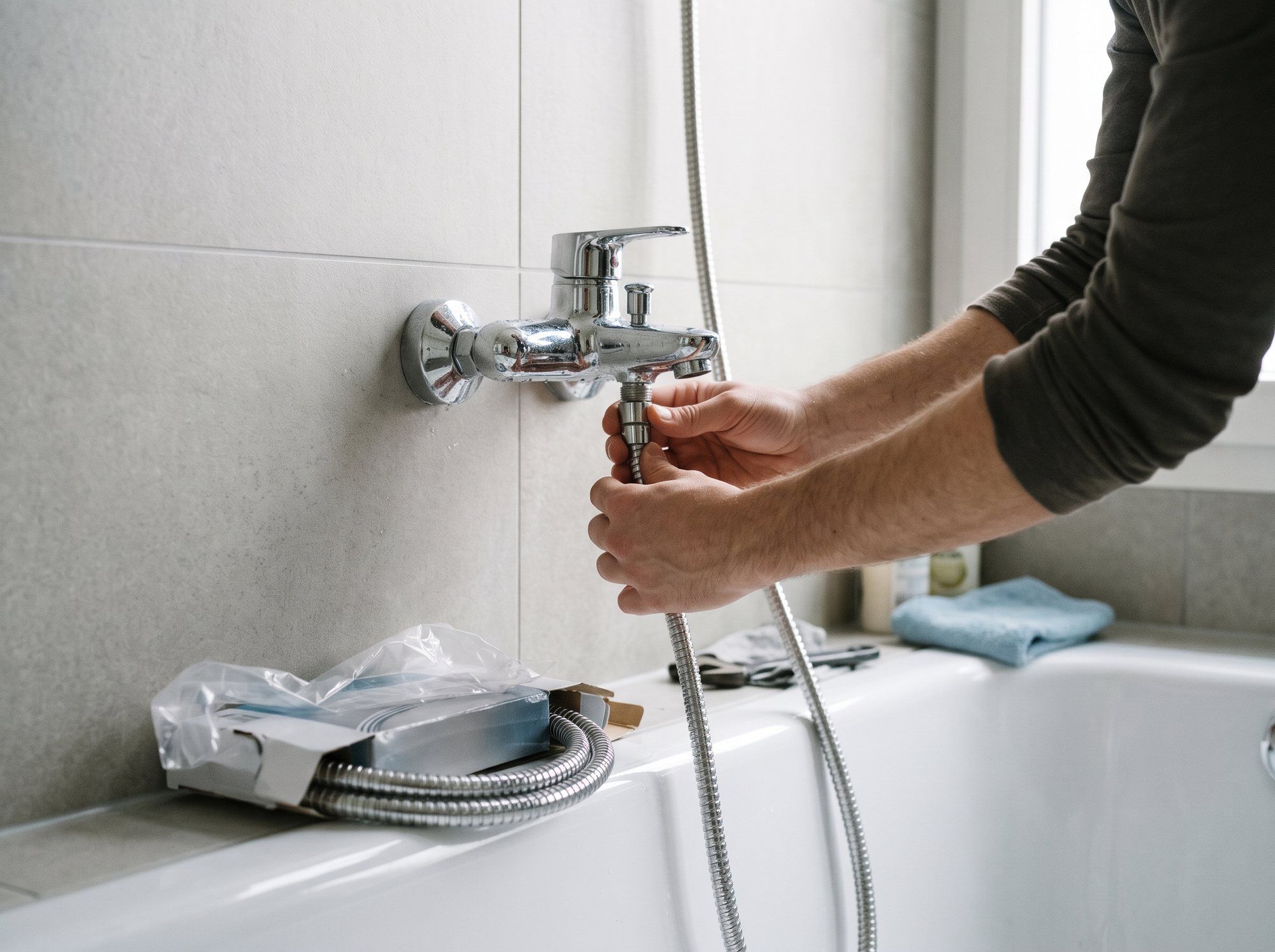
In short: Minor maintenance covers small cleaning and repair jobs that tenants can do themselves without specialist knowledge, for example replacing a fuse or changing a shower hose. The basis is Art. 259 CO. Anything that requires a professional remains the landlord's responsibility.
What is minor maintenance?
Minor maintenance is the tenants' statutory duty to remedy small defects themselves and at their own expense. Art. 259 CO describes it as defects that can be remedied by minor cleaning or repairs required for ordinary maintenance; tenants remedy these at their own expense in accordance with local custom.
The basic rule is the other way round: the landlord must hand over the apartment in a condition fit for the intended use and keep it that way (Art. 256 CO). Minor maintenance is an exception to this. The High Court of the canton of Bern therefore holds that Art. 259 CO must be interpreted narrowly and that, in case of doubt, a repair is the landlord's responsibility.
According to the same decision, ordinary maintenance includes dirt from normal use and minor signs of wear within the tenants' immediate reach.
What is and is not minor maintenance?
Minor maintenance covers what an average tenant can do with simple handling and without specialist knowledge. As soon as a professional is needed, the duty ends.
| Usually minor maintenance | Not minor maintenance |
|---|---|
| Cleaning the apartment and fittings | Unblocking the main sewer pipe |
| Replacing blown fuses | Repairing the dishwasher |
| Replacing light bulbs and lamps | Repairing the ceramic hob |
| Replacing the shower hose | Replacing fridge hinges |
| Replacing baking trays and similar accessories | Repairing the top heating element of the oven |
| Unblocking the washbasin trap if it is easy to open | Replacing the heating ignition electrode |
| Oiling hinges, tightening loose screws | Repairing a full-extension kitchen drawer |
| Cleaning shutters if this is only possible with scaffolding or is dangerous |
Most of the examples in the right-hand column come from court decisions: the Zurich District Court classified the repair of an oven's top heating element and the replacement of an ignition electrode as no longer minor, and the Horgen Rental Court did the same for repairing a dishwasher and a ceramic hob and replacing fridge hinges. The Bern High Court decided the same for a full-extension drawer, because spare parts and fitting require expertise.
Is there an amount limit for minor maintenance?
No, the law does not name an amount in francs. It only refers to local custom.
In practice there is a point of reference, however: according to the Zurich courts, conciliation authorities and rental courts currently treat CHF 150 per repair as a guideline for residential tenancies. The specialist literature cited in the Bern decision also mentions around CHF 150.
Important for property managers: the amount alone does not decide. The Bern High Court expressly held that the criterion is not an upper limit in francs but the need for a professional. A CHF 90 repair by a service technician is therefore not minor maintenance.
What applies if the tenancy agreement says something else?
A tenancy agreement can describe minor maintenance in more detail, but cannot extend it to the tenants' disadvantage. Derogations from the landlord's maintenance duty to the tenants' disadvantage are void in tenancy agreements for residential and commercial premises (Art. 256 para. 2 CO). The Zurich courts hold that clauses imposing more than minor maintenance on tenants are invalid.
Three points from case law:
- Amount clauses: an amount in the agreement, such as “minor maintenance up to CHF 200”, does not make a professional repair the tenant's responsibility. In the Bern case, the agreement contained such an amount, but the court still based its decision on the need for a professional.
- Service subscriptions: an obligation to take out service contracts for a dishwasher or washing machine is not permitted insofar as it shifts work by a professional onto the tenants.
- Standard-form agreements: they do not automatically count as local custom.
How does minor maintenance differ from a defect?
A defect that tenants neither caused nor have to remedy themselves is the landlord's responsibility. For such defects, the rights under Art. 259a ff. CO apply. Tenants can require the landlord to:
- remedy the defect,
- reduce the rent proportionately (Art. 259d CO),
- pay damages (Art. 259e CO),
- take over a legal dispute with third parties (Art. 259f CO).
For apartments, tenants can also deposit the rent. To do so, they must set the landlord a reasonable deadline in writing and announce the deposit in writing (Art. 259g CO). If the landlord does not remedy a known defect within a reasonable period, tenants can, depending on its severity, terminate without notice or have the defect remedied at the landlord's expense (Art. 259b CO).
For property managers this means: a report that is wrongly rejected as minor maintenance can lead to a rent reduction or a remedy at the landlord's expense.
Who pays if the tenants caused the damage?
Tenants bear damage they are responsible for, regardless of minor maintenance. Tenants must use the property with care (Art. 257f CO), and the rights in respect of defects under Art. 259a CO only apply to defects they are not responsible for. The Zurich courts give pest infestation due to neglected cleaning as an example.
Not every small share of responsibility rules out the rights in respect of defects. According to the Bern High Court, tenants of an ordinary apartment cannot, for example, be required to cross-ventilate several times a day.
How property managers classify damage reports as minor maintenance
For property managers, minor maintenance is above all a triage question: every report must quickly be assigned to the right category. A clear process prevents unnecessary call-outs and disputes over invoices.
1. Record the report completely. Location, affected component or appliance, description and since when. Tenants must report defects they do not have to remedy themselves, otherwise they are liable for the resulting damage (Art. 257g CO).
2. Triage into three categories. Minor maintenance (simple handling, no specialist knowledge), defect (landlord) or damage caused by tenants. Test question: can an average tenant do this without a professional? In case of doubt, treat it as a defect.

3. Minor maintenance: inform tenants clearly. Briefly explain why the job is the tenant's responsibility and, if possible, say where to get the spare part. If the caretaker does the job for a charge, this should be agreed and announced beforehand.
4. Defect: place the order. Instruct the caretaker or tradespeople, arrange an appointment with the tenants and make sure the defect is remedied within a reasonable period (Art. 259b CO).
5. Report back on the status. Tenants learn who is coming and when. This reduces follow-up calls and emails.
6. Document. File the report, classification, order and completion per apartment. This helps with recurring cases and at the apartment handover.
In the Allthings ticketing system, requests from phone, email, app and web end up in one place as tickets and go straight to the person responsible or to partner companies. Via the tenant portal, tenants receive messages, appointments and documents digitally.
What applies when moving out?
When moving out, tenants must return the apartment in the condition resulting from use in accordance with the contract (Art. 267 CO). Minor maintenance left undone during the tenancy, such as a defective shower hose, can therefore become an issue at the handover. The landlord must check the condition on return and report defects the tenants are liable for immediately (Art. 267a CO). More on this in the article on the apartment handover.
How long appliances and components last and what share of the current value tenants bear in the event of damage is shown in the lifespan table with current value calculator.
Sources
- Swiss Code of Obligations (SR 220): Art. 256, 257f, 257g, 259, 259a to 259g, 267 and 267a CO, fedlex.admin.ch, version of 1 January 2026
- Courts of the canton of Zurich: topic page on cleaning and minor repairs (gerichte-zh.ch, accessed 25.10.2026)
- High Court of the canton of Bern, decision ZK 12 157 of 27 June 2012 (with references to the Zurich District Court, mp 2007 p. 221 ff., and the Horgen Rental Court, mp 2007 p. 218 ff.)
Information as of 25 October 2026.